The State of Hybrid SASE: Built-In vs. Bolted-On
The State of Hybrid SASE: Built-In vs. Bolted-On

Check Point Hybrid SASE: A Unified Architecture or a Collection of Separate Solutions?
Hybrid SASE is not a label – it is an architectural commitment.
Many enterprises pay twice for SASE: once for the platform, and again for the overhead of integrating and managing components never designed to work as one architecture. Check Point’s Hybrid SASE takes a different path: a single operating model that unifies access and policy. That distinction decides whether traffic is secured and routed predictably – or whether teams spend years working around architectural seams.
Take a typical workday. A remote employee connects from a managed laptop, a branch office user accesses a private application, and a contractor opens a corporate app from an unmanaged device. If each path depends on a different product, policy model, console, or tunnel architecture, “hybrid” becomes another integration project. Hybrid-by-design SASE avoids that trap by applying one operating model across users, devices, branches, applications, gateways, and private connectivity.
This is where the difference between hybrid as a deployment option and hybrid as an architectural principle becomes clear.
What Is SASE?
SASE, or Secure Access Service Edge, is an architecture that applies network connectivity and security policies consistently, regardless of where a user is located, which device they are using, or which system they are accessing.
In a traditional model, remote-user traffic is first routed back through the organization’s central office or data center before being forwarded to the internet or a cloud application. This model was suitable when most employees worked from one office and used the same corporate network. In today’s distributed environment, however, it can increase latency and make management more complex.
A SASE architecture securely connects users to the applications and systems they need through a security point located close to them. Access decisions are based on factors such as the user’s identity, device posture, location, requested resource, and the organization’s security policies.
Hybrid SASE extends this cloud-delivered security model by integrating it with the organization’s existing data centers, firewalls, branch networks, and internal systems. This enables organizations to transition gradually toward a modern architecture without replacing their entire infrastructure at once.
Not Everything Called “Hybrid” Is a Unified Architecture
Many solutions describe themselves as Hybrid SASE because they support remote users, branch offices, data centers, and cloud environments. However, simply supporting these environments does not necessarily mean that the solution provides a genuinely unified architecture.
For example, an organization may secure remote-user access with one product, branch connectivity with another appliance, and SaaS usage with a third platform. Even when these products exchange information, the organization is still operating several separate environments if each product has its own management console, policies, logs, and licensing model.
From the outside, this may appear to be a single solution. In practice, however, the IT team may still need to configure the same rules across multiple systems, combine separate reports, and manually identify inconsistencies in connectivity or security policies.
Check Point explains that Hybrid SASE solutions can generally be viewed across three architectural levels.
Hybrid SD-WAN, Without the Bolt-On
Branches connect via secure tunnel to selected Check Point SASE regions and tenant Cloud Edge Gateways. Policy determines whether private, SaaS, or internet traffic is routed through Check Point SASE, while existing SD-WAN can continue to handle underlay path selection. Check Point SASE recognizes more than 10,000 applications for routing and policy decisions, with automated steering and link failover. For traffic routed through the SASE architecture, security controls and private connectivity can apply based on policy, topology, and configuration. This allows organizations to modernize branch access without treating SD-WAN and SASE as disconnected architectures.
The Economics of Built-In
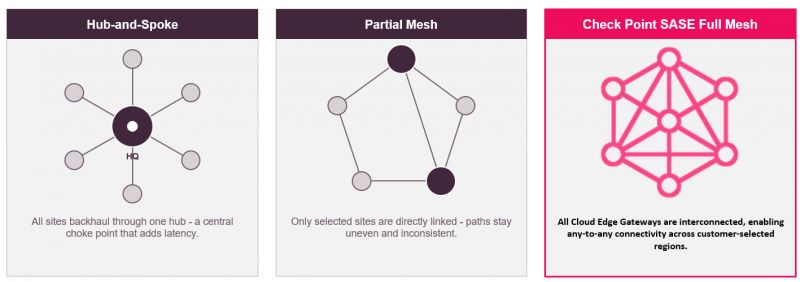
A full mesh, hybrid-by-design SASE architecture can reduce operational complexity and may reduce network and cloud connectivity costs by:
- Reducing unnecessary VPN backhaul
- Reducing dependency on centralized inspection hubs
- Reducing reliance on some dedicated cloud-connectivity patterns where Check Point SASE private connectivity meets the organization’s performance, security, and data residency requirements
- Managing Private Access, Internet Access, DNS Security, firewall policy, threat prevention, users, devices, networks, gateways, tunnels, and security events through one unified SASE operating model
Actual savings depend on topology, traffic mix, data residency needs, configuration, and existing contracts. The point is architectural: when full mesh private connectivity and unified security are built into the platform, customers do not need to assemble multiple components to achieve one operating model
Hybrid SASE is not simply a technology for protecting remote employees and cloud applications. It represents an architectural transformation in how organizations manage their networks, user access, and cybersecurity.
A solution assembled by connecting independent products may meet short-term requirements. However, as the number of systems grows, management complexity, operational costs, and security risks can increase.
A natively unified Hybrid SASE architecture allows organizations to retain their existing infrastructure while gradually transitioning toward cloud-delivered security. It also enables remote employees, branch offices, data centers, and internal systems to be governed through consistent policies.
Vertexmon LLC delivers and implements advanced cybersecurity and network infrastructure solutions for organizations in Mongolia. Through Check Point Hybrid SASE, Vertexmon provides an integrated approach to securing remote users, branch locations, data centers, cloud environments, SaaS applications, and internet access under a unified security policy.
To assess your organization’s current network and remote-access environment or to learn more about Check Point Hybrid SASE, please contact the specialists at Vertexmon LLC.
Блокын гарчиг / html
Vertexmon — Delivering Enterprise Cybersecurity Solutions
.png)