2026 Cloud Security Report: Securing the AI Transformation
2026 Cloud Security Report: Securing the AI Transformation

2026 Cloud Security Report: Securing the AI Transformation
Artificial Intelligence is taking digital transformation to a new level for organizations. Automated customer service, intelligent cybersecurity, predictive analytics, AI agents, and API-driven workflows are increasingly being developed in cloud environments, directly influencing the way organizations operate on a daily basis. Over the past two years, AI has moved beyond the experimentation phase and has become an integral part of core business processes, competitive advantage, and technology strategies.
Despite the rapid adoption of AI, the security architecture required to protect cloud environments, networks, SaaS platforms, data centers, endpoints, and AI runtimes has not yet evolved at the same pace. In other words, while organizations are rapidly deploying AI into production environments, essential capabilities such as visibility, policy enforcement, data protection, and real-time prevention have not yet reached the required level of maturity.
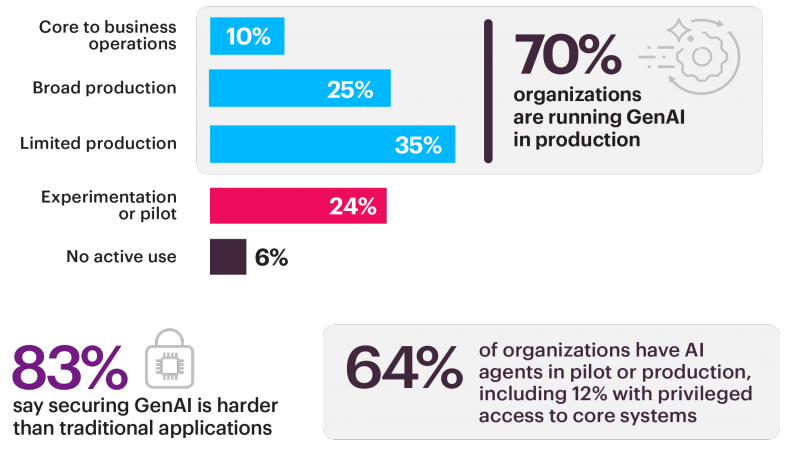
According to Check Point’s 2026 Cloud Security Report, 70% of organizations are running Generative AI (GenAI) workloads in production environments, while 64% have already deployed AI agents for real-world use cases. As AI agents gain the ability to access data, initiate workflows, and execute actions across multiple systems, cybersecurity is shifting beyond simply monitoring sensitive information entered by users. Organizations now need to manage and control what actions AI systems themselves are authorized to perform.
Блокын гарчиг / html
AI Deployment Is Moving Faster Than Security Readiness
According to the survey, 70% of organizations are already running Generative AI (GenAI) workloads in production environments. In addition, 64% have deployed AI agents either in pilot stages or for real-world operational use, while 12% have granted these AI agents privileged access to core systems.
This shift demonstrates that security teams can no longer focus solely on monitoring what information employees provide to AI systems. They must also manage and govern what data AI systems can access, what actions they are authorized to perform, and how those actions are controlled.
Traditional security models have largely been built around human-driven activities, predictable application traffic, and clearly defined network perimeters. However, AI-driven environments are becoming increasingly API-driven, dynamic, and machine-operated, creating the need for security policies and controls to be applied closer to the point of action and enforced in real time.
AI Risks Are Evolving into Real-World Attack Scenarios
AI-related security risks have already become a tangible challenge for organizations. 54% of organizations reported experiencing at least one confirmed AI-related security incident, while 24% indicated that such incidents may have occurred but lacked sufficient telemetry and visibility to verify them.
In other words, 78% of organizations are either facing confirmed AI-related security risks or are unable to fully rule them out due to limited detection capabilities.
The primary risks are associated with:
- Unauthorized or shadow AI usage within organizations
- AI-generated phishing and deepfake attacks
- The risk of sensitive data exposure through AI services
As AI adoption accelerates, organizations must expand their security strategies beyond traditional threat protection and establish comprehensive controls for AI usage, data access, and AI-driven activities.
.png)
Strategy Exists, but Execution Infrastructure Remains a Challenge
77% of organizations have updated their security strategies in response to the rapid adoption of AI. However, only 26% believe they have the necessary architecture to effectively enforce and operationalize those strategies.
If cloud, data center, SaaS, and endpoint environments each rely on separate policies, management consoles, and detection mechanisms, organizations risk creating security blind spots whenever AI workloads move across different environments.
To secure AI-driven operations effectively, organizations need a unified security architecture that provides consistent visibility, policy enforcement, and protection across all environments.
.png)

Visibility and Data Protection Remain Major Challenges
The first step in securing AI environments is understanding exactly which AI tools, services, and data flows are being used across the organization. However, only 5% of organizations reported having complete visibility into their AI tools, services, and data flows.
Browser-based AI assistants, Large Language Model (LLM) APIs, SaaS-based AI features, and AI agents may not be fully identified through traditional discovery tools, creating potential blind spots in security monitoring.
Every interaction with AI—including submitting prompts, uploading documents, processing source code, or receiving model-generated responses—creates data movement that must be monitored and controlled.
According to the survey, 61% of organizations reported having limited or unclear visibility into where sensitive data travels during AI processing. Meanwhile, only 15% have implemented AI-specific Data Loss Prevention (DLP) capabilities.
As AI adoption expands, organizations need enhanced visibility, intelligent data protection, and dedicated security controls designed specifically for AI-driven workflows.
Moving Toward a Unified Security Architecture
AI security cannot be solved simply by adding a single new security tool. Organizations need to establish a comprehensive approach that includes creating an AI asset inventory, managing user access through defined policies, implementing runtime controls for AI applications, assigning policy enforcement responsibilities to appropriate teams, and ultimately transitioning toward a unified security architecture across hybrid environments.
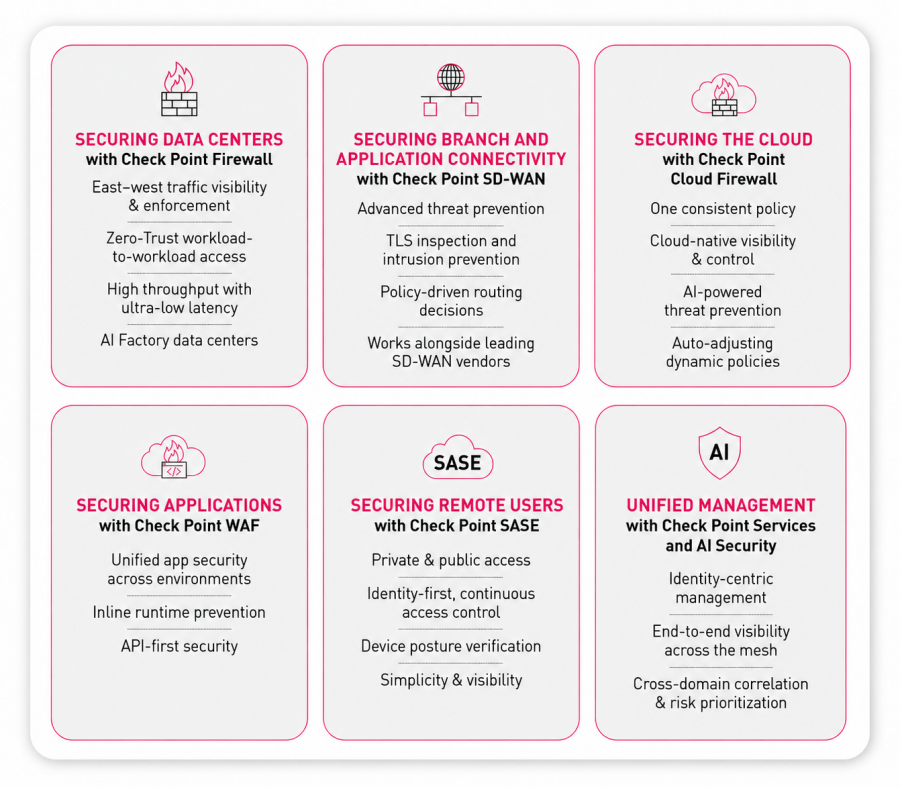
The Hybrid Mesh Network Security model highlighted in Check Point’s report aims to connect data centers, cloud environments, branch offices, applications, remote users, and unified management into a single security operating model.
The core principle is to define security policies centrally while positioning enforcement closer to workloads, network traffic, and user interactions—enabling more consistent protection, improved visibility, and faster response across the entire digital environment.
Securing AI Transformation with a Unified Security Foundation
To enable secure AI transformation, Check Point’s cloud and hybrid security solutions provide organizations with a unified foundation for protecting modern digital environments. The portfolio includes Check Point Cloud Firewall, Check Point WAF, Check Point SASE, Check Point Firewall, Check Point SD-WAN, and Check Point Services and AI Security solutions.
These solutions deliver the security capabilities required for the AI era, including:
- Cloud-native visibility
- AI-powered threat prevention
- Zero-trust workload access
- Inline runtime prevention
- Identity-centric security management
- Cross-domain security correlation
Together, these capabilities help organizations establish comprehensive protection across AI workloads, cloud environments, SaaS platforms, and hybrid infrastructures.
Vertexmon, in partnership with Check Point, continues to introduce advanced cybersecurity solutions to organizations in Mongolia, providing expert consultation, security architecture planning, solution implementation, and post-deployment support services tailored to each organization’s needs.
Organizations looking to strengthen the security of their AI, cloud, SaaS, and hybrid environments can rely on Vertexmon’s expertise and Check Point’s advanced security technologies to achieve more unified visibility, effective policy enforcement, and proactive threat prevention across their digital ecosystem.
Блокын гарчиг / html
Vertexmon, an implementer of information security solutions.
.png)