Check Point Exposure Management – Comprehensive Security Solution for Effective Risk Reduction
Check Point Exposure Management – Comprehensive Security Solution for Effective Risk Reduction

Check Point Exposure Management – Comprehensive Security Solution for Effective Risk Reduction
Introducing Check Point's New 2026 Solution: Check Point Exposure Management
Turn Cyber Threat Intelligence into Actionable Protection
Why Does It Matter?
Many organizations can identify cyber risks, but struggle to reduce them effectively. Check Point Exposure Management bridges this gap by consolidating fragmented security data, prioritizing the most critical exposures, and transforming intelligence into validated security actions.
Because reducing risk isn't about having another dashboard—it's about taking the right action.
How Does It Work?
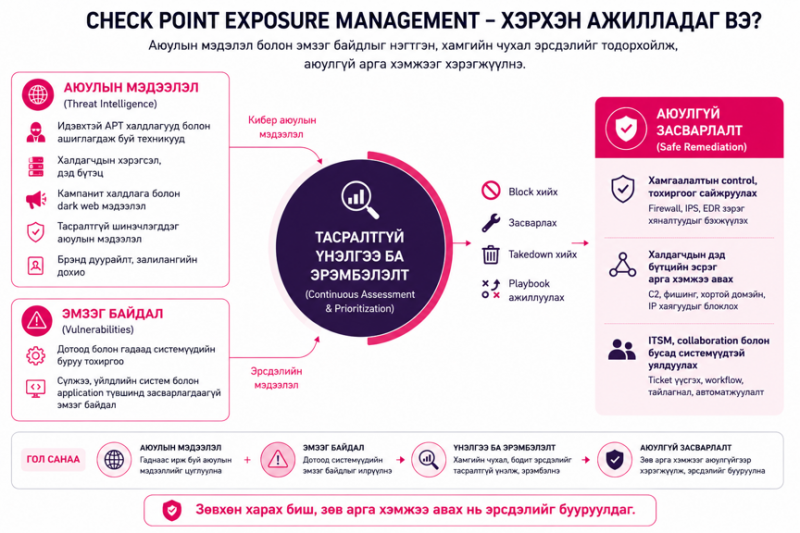
Check Point Exposure Management correlates external cyber threat intelligence with internal security telemetry to identify the exposures that are most likely to be exploited.
Attackers do not begin with a list of CVEs. They target an organization's attack surface—every externally visible asset that could potentially be exploited. This includes exposed systems, security misconfigurations, inactive security controls, compromised credentials, phishing kits, and leaked information circulating on the dark web.
Check Point Exposure Management continuously analyzes these external exposure signals alongside telemetry collected from the organization's existing security tools to determine which risks present the highest likelihood of real-world exploitation.
As a result, security teams gain more than visibility into vulnerabilities—they understand which risks require immediate remediation and which defensive actions will deliver the greatest reduction in organizational risk.
Prioritize the Risks That Matter Most
Simply identifying vulnerabilities is not enough. Check Point Exposure Management continuously evaluates vulnerabilities, misconfigurations, security gaps, and exposures across on-premises infrastructure, networks, endpoints, and cloud environments. Each exposure is assessed based on multiple factors,
including:
- Likelihood of exploitation
- External visibility to attackers
- Effectiveness of existing security controls
- Potential business impact
Instead of being overwhelmed by thousands of alerts, security teams receive a prioritized view of the exposures that represent the greatest risk to the business, enabling faster and more informed decision-making.
Reduce Risk Without Disrupting Business Operations
Check Point Exposure Management helps organizations safely remediate identified exposures through validated mitigation strategies.
Recommended actions include:
- Virtual patching
- Intrusion Prevention System (IPS) protection
- Adaptive blocklisting
- Phishing takedown
- Security policy optimization
These measures can be implemented while minimizing operational disruption, allowing organizations to strengthen security without impacting business continuity.
From Security Data to Proven Protection
Security teams do not need more alerts—they need confidence in knowing:
- Which risks are the most critical
- What should be remediated first
- Which mitigation actions will have the greatest impact
Check Point Exposure Management unifies cyber threat intelligence, vulnerability data, and security posture information into a single analytical platform.
Rather than simply identifying what is wrong, it enables organizations to take the right action at the right time with validated, low-risk remediation strategies.
Its true value lies not in generating more visibility, but in enabling organizations to reduce the right risks through the right actions.
Key Benefits
- Fewer alerts, more effective remediation
- Faster and safer remediation workflows
- Continuous reduction of organizational cyber risk
Why Organizations Choose Check Point
Check Point Exposure Management combines external threat intelligence with internal security telemetry to identify and prioritize the exposures that matter most.
This enables organizations to move from reactive incident response to proactive risk reduction.
The solution also integrates seamlessly with existing security and IT ecosystems, helping organizations implement protective measures faster, more efficiently, and with greater confidence.
Conclusion
Check Point Exposure Management is a proactive cybersecurity solution that unifies cyber threat intelligence, exposure assessment, and validated remediation into a single continuous process.
Rather than simply highlighting risks, it empowers organizations to reduce them through proven mitigation strategies, enabling measurable improvements in security posture while accelerating secure and effective risk management.
Vertexmon, an implementer of information security solutions
.png)